

可视化VIT中的注意力
创始人
2024-05-13 21:29:26
2022年, Vision Transformer (ViT)成为卷积神经网络(cnn)的有力竞争对手,卷积神经网络目前是计算机视觉领域的最先进技术,广泛应用于许多图像识别应用。在计算效率和精度方面,ViT模型超过了目前最先进的(CNN)几乎四倍。
ViT是如何工作的?
ViT模型的性能取决于优化器、网络深度和特定于数据集的超参数等, 标准 ViT stem 采用 16 *16 卷积和 16 步长。

CNN 将原始像素转换为特征图。然后,tokenizer 将特征图转换为一系列令牌,这些令牌随后被送入transformer。然后transformer使用注意力方法生成一系列输出令牌。
projector 最终将输出令牌标记重新连接到特征图。
vision transformer模型的整体架构如下:
- 将图像拆分为补丁(固定大小)
- 展平图像块
- 从这些展平的图像块中创建低维线性嵌入
- 包括位置嵌入
- 将序列作为输入发送到transformer编码器
- 使用图像标签预训练 ViT 模型,然后在广泛的数据集上进行训练
- 在图像分类的下游数据集进行微调
可视化注意力
ViT中最主要的就是注意力机制,所以可视化注意力就成为了解ViT的重要步骤,所以我们这里介绍如何可视化ViT中的注意力
导入库
importosimporttorchimportnumpyasnpimportmathfromfunctoolsimportpartialimporttorchimporttorch.nnasnnimportipywidgetsaswidgetsimportiofromPILimportImagefromtorchvisionimporttransformsimportmatplotlib.pyplotaspltimportnumpyasnpfromtorchimportnnimportwarningswarnings.filterwarnings("ignore")
创建一个VIT
deftrunc_normal_(tensor, mean=0., std=1., a=-2., b=2.):# type: (Tensor, float, float, float, float) -> Tensorreturn_no_grad_trunc_normal_(tensor, mean, std, a, b)def_no_grad_trunc_normal_(tensor, mean, std, a, b):# Cut & paste from PyTorch official master until it's in a few official releases - RW# Method based on https://people.sc.fsu.edu/~jburkardt/presentations/truncated_normal.pdfdefnorm_cdf(x):# Computes standard normal cumulative distribution functionreturn (1.+math.erf(x/math.sqrt(2.))) /2.defdrop_path(x, drop_prob: float=0., training: bool=False):ifdrop_prob==0.ornottraining:returnxkeep_prob=1-drop_prob# work with diff dim tensors, not just 2D ConvNetsshape= (x.shape[0],) + (1,) * (x.ndim-1)random_tensor=keep_prob+ \torch.rand(shape, dtype=x.dtype, device=x.device)random_tensor.floor_() # binarizeoutput=x.div(keep_prob) *random_tensorreturnoutputclassDropPath(nn.Module):"""Drop paths (Stochastic Depth) per sample (when applied in main path of residual blocks)."""def__init__(self, drop_prob=None):super(DropPath, self).__init__()self.drop_prob=drop_probdefforward(self, x):returndrop_path(x, self.drop_prob, self.training)classMlp(nn.Module):def__init__(self, in_features, hidden_features=None, out_features=None, act_layer=nn.GELU, drop=0.):super().__init__()out_features=out_featuresorin_featureshidden_features=hidden_featuresorin_featuresself.fc1=nn.Linear(in_features, hidden_features)self.act=act_layer()self.fc2=nn.Linear(hidden_features, out_features)self.drop=nn.Dropout(drop)defforward(self, x):x=self.fc1(x)x=self.act(x)x=self.drop(x)x=self.fc2(x)x=self.drop(x)returnxclassAttention(nn.Module):def__init__(self, dim, num_heads=8, qkv_bias=False, qk_scale=None, attn_drop=0., proj_drop=0.):super().__init__()self.num_heads=num_headshead_dim=dim//num_headsself.scale=qk_scaleorhead_dim**-0.5self.qkv=nn.Linear(dim, dim*3, bias=qkv_bias)self.attn_drop=nn.Dropout(attn_drop)self.proj=nn.Linear(dim, dim)self.proj_drop=nn.Dropout(proj_drop)defforward(self, x):B, N, C=x.shapeqkv=self.qkv(x).reshape(B, N, 3, self.num_heads, C//self.num_heads).permute(2, 0, 3, 1, 4)q, k, v=qkv[0], qkv[1], qkv[2]attn= (q@k.transpose(-2, -1)) *self.scaleattn=attn.softmax(dim=-1)attn=self.attn_drop(attn)x= (attn@v).transpose(1, 2).reshape(B, N, C)x=self.proj(x)x=self.proj_drop(x)returnx, attnclassBlock(nn.Module):def__init__(self, dim, num_heads, mlp_ratio=4., qkv_bias=False, qk_scale=None, drop=0., attn_drop=0.,drop_path=0., act_layer=nn.GELU, norm_layer=nn.LayerNorm):super().__init__()self.norm1=norm_layer(dim)self.attn=Attention(dim, num_heads=num_heads, qkv_bias=qkv_bias, qk_scale=qk_scale, attn_drop=attn_drop, proj_drop=drop)self.drop_path=DropPath(drop_path) ifdrop_path>0.elsenn.Identity()self.norm2=norm_layer(dim)mlp_hidden_dim=int(dim*mlp_ratio)self.mlp=Mlp(in_features=dim, hidden_features=mlp_hidden_dim,act_layer=act_layer, drop=drop)defforward(self, x, return_attention=False):y, attn=self.attn(self.norm1(x))ifreturn_attention:returnattnx=x+self.drop_path(y)x=x+self.drop_path(self.mlp(self.norm2(x)))returnxclassPatchEmbed(nn.Module):""" Image to Patch Embedding"""def__init__(self, img_size=224, patch_size=16, in_chans=3, embed_dim=768):super().__init__()num_patches= (img_size//patch_size) * (img_size//patch_size)self.img_size=img_sizeself.patch_size=patch_sizeself.num_patches=num_patchesself.proj=nn.Conv2d(in_chans, embed_dim,kernel_size=patch_size, stride=patch_size)defforward(self, x):B, C, H, W=x.shapex=self.proj(x).flatten(2).transpose(1, 2)returnxclassVisionTransformer(nn.Module):""" Vision Transformer """def__init__(self, img_size=[224], patch_size=16, in_chans=3, num_classes=0, embed_dim=768, depth=12,num_heads=12, mlp_ratio=4., qkv_bias=False, qk_scale=None, drop_rate=0., attn_drop_rate=0.,drop_path_rate=0., norm_layer=nn.LayerNorm, **kwargs):super().__init__()self.num_features=self.embed_dim=embed_dimself.patch_embed=PatchEmbed(img_size=img_size[0], patch_size=patch_size, in_chans=in_chans, embed_dim=embed_dim)num_patches=self.patch_embed.num_patchesself.cls_token=nn.Parameter(torch.zeros(1, 1, embed_dim))self.pos_embed=nn.Parameter(torch.zeros(1, num_patches+1, embed_dim))self.pos_drop=nn.Dropout(p=drop_rate)# stochastic depth decay ruledpr= [x.item() forxintorch.linspace(0, drop_path_rate, depth)]self.blocks=nn.ModuleList([Block(dim=embed_dim, num_heads=num_heads, mlp_ratio=mlp_ratio, qkv_bias=qkv_bias, qk_scale=qk_scale,drop=drop_rate, attn_drop=attn_drop_rate, drop_path=dpr[i], norm_layer=norm_layer)foriinrange(depth)])self.norm=norm_layer(embed_dim)# Classifier headself.head=nn.Linear(embed_dim, num_classes) ifnum_classes>0elsenn.Identity()trunc_normal_(self.pos_embed, std=.02)trunc_normal_(self.cls_token, std=.02)self.apply(self._init_weights)def_init_weights(self, m):ifisinstance(m, nn.Linear):trunc_normal_(m.weight, std=.02)ifisinstance(m, nn.Linear) andm.biasisnotNone:nn.init.constant_(m.bias, 0)elifisinstance(m, nn.LayerNorm):nn.init.constant_(m.bias, 0)nn.init.constant_(m.weight, 1.0)definterpolate_pos_encoding(self, x, w, h):npatch=x.shape[1] -1N=self.pos_embed.shape[1] -1ifnpatch==Nandw==h:returnself.pos_embedclass_pos_embed=self.pos_embed[:, 0]patch_pos_embed=self.pos_embed[:, 1:]dim=x.shape[-1]w0=w//self.patch_embed.patch_sizeh0=h//self.patch_embed.patch_size# we add a small number to avoid floating point error in the interpolation# see discussion at https://github.com/facebookresearch/dino/issues/8w0, h0=w0+0.1, h0+0.1patch_pos_embed=nn.functional.interpolate(patch_pos_embed.reshape(1, int(math.sqrt(N)), int(math.sqrt(N)), dim).permute(0, 3, 1, 2),scale_factor=(w0/math.sqrt(N), h0/math.sqrt(N)),mode='bicubic',)assertint(w0) ==patch_pos_embed.shape[-2] andint(h0) ==patch_pos_embed.shape[-1]patch_pos_embed=patch_pos_embed.permute(0, 2, 3, 1).view(1, -1, dim)returntorch.cat((class_pos_embed.unsqueeze(0), patch_pos_embed), dim=1)defprepare_tokens(self, x):B, nc, w, h=x.shapex=self.patch_embed(x) # patch linear embedding# add the [CLS] token to the embed patch tokenscls_tokens=self.cls_token.expand(B, -1, -1)x=torch.cat((cls_tokens, x), dim=1)# add positional encoding to each tokenx=x+self.interpolate_pos_encoding(x, w, h)returnself.pos_drop(x)defforward(self, x):x=self.prepare_tokens(x)forblkinself.blocks:x=blk(x)x=self.norm(x)returnx[:, 0]defget_last_selfattention(self, x):x=self.prepare_tokens(x)fori, blkinenumerate(self.blocks):ifi创建可视化函数
deftransform(img, img_size):img=transforms.Resize(img_size)(img)img=transforms.ToTensor()(img)returnimgdefvisualize_predict(model, img, img_size, patch_size, device):img_pre=transform(img, img_size)attention=visualize_attention(model, img_pre, patch_size, device)plot_attention(img, attention)defvisualize_attention(model, img, patch_size, device):# make the image divisible by the patch sizew, h=img.shape[1] -img.shape[1] %patch_size, img.shape[2] - \img.shape[2] %patch_sizeimg=img[:, :w, :h].unsqueeze(0)w_featmap=img.shape[-2] //patch_sizeh_featmap=img.shape[-1] //patch_sizeattentions=model.get_last_selfattention(img.to(device))nh=attentions.shape[1] # number of head# keep only the output patch attentionattentions=attentions[0, :, 0, 1:].reshape(nh, -1)attentions=attentions.reshape(nh, w_featmap, h_featmap)attentions=nn.functional.interpolate(attentions.unsqueeze(0), scale_factor=patch_size, mode="nearest")[0].cpu().numpy()returnattentionsdefplot_attention(img, attention):n_heads=attention.shape[0]plt.figure(figsize=(10, 10))text= ["Original Image", "Head Mean"]fori, figinenumerate([img, np.mean(attention, 0)]):plt.subplot(1, 2, i+1)plt.imshow(fig, cmap='inferno')plt.title(text[i])plt.show()plt.figure(figsize=(10, 10))foriinrange(n_heads):plt.subplot(n_heads//3, 3, i+1)plt.imshow(attention[i], cmap='inferno')plt.title(f"Head n: {i+1}")plt.tight_layout()plt.show()classLoader(object):def__init__(self):self.uploader=widgets.FileUpload(accept='image/*', multiple=False)self._start()def_start(self):display(self.uploader)defgetLastImage(self):try:foruploaded_filenameinself.uploader.value:uploaded_filename=uploaded_filenameimg=Image.open(io.BytesIO(bytes(self.uploader.value[uploaded_filename]['content'])))returnimgexcept:returnNonedefsaveImage(self, path):withopen(path, 'wb') asoutput_file:foruploaded_filenameinself.uploader.value:content=self.uploader.value[uploaded_filename]['content']output_file.write(content)
对一个图像的注意力进行可视化
device = torch.device("cuda") if torch.cuda.is_available() else torch.device("cpu")if device.type == "cuda":torch.cuda.set_device(1)name_model = 'vit_small'patch_size = 8model = VitGenerator(name_model, patch_size, device, evaluate=True, random=False, verbose=True)# Visualizing Dog Imagepath = '/content/corgi_image.jpg'img = Image.open(path)factor_reduce = 2img_size = tuple(np.array(img.size[::-1]) // factor_reduce) visualize_predict(model, img, img_size, patch_size, device)
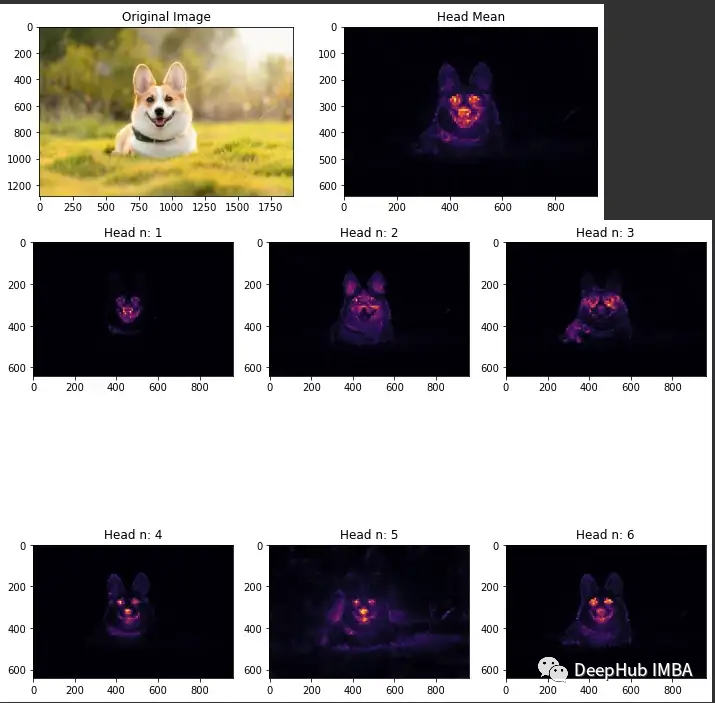

本文代码
https://avoid.overfit.cn/post/4c0e8cb7959641eb9b92c1d5a3c7161c
作者:Aryan Jadon
下一篇:C语言刷题之摩尔投票法
相关内容
热门资讯
藤信学子执笔绘梦,国美考级见证...
藤信学子执笔绘梦国美考级见证成长西安藤信学校顺利举办中国美术学院社会艺术水平考级墨香浸校园,艺笔绘初...
冀时评丨一张“国际通行证”看塞...
(来源:河北新闻网)转自:河北新闻网青山有“价”、绿水含“金”。近日,塞罕坝机械林场成功通过CFCC...
白银牛市生变?分析师警告:高价...
财联社1月17日讯(编辑 卞纯)在贵金属本轮凌厉的涨势中,白银表现远超黄金,但这波涨势正遭遇一项现实...
《轧戏》热播拉升文旅热 “新世...
中新网上海1月17日电 (张践)近期,由陈星旭、卢昱晓领衔主演的电视剧《轧戏》热播,凭借紧凑剧情收获...
最新版最新廉洁从政准则条例全文...
第一章 总 则第一条 为贯彻实施《中国共产党党员领导干部廉洁从政若干准则》(以下简称《廉政准则》),...